Why WikiNative Studio is essential to my Wikipedia work
Before I write a Wikipedia sentence, I need to know what the published evidence supports. Before I change an existing sentence, I need to understand why it is there. My client needs to see that reasoning, question it and contribute useful information while I retain a clear record of the proposed work.
I built WikiNative Studio as subscription software for managing Wikipedia projects. Consultancy is a separate service I offer to active subscribers, including eligible trial subscribers. Studio keeps the sources, draft, discussion and revisions together, so each editorial decision remains attached to the evidence and wording that produced it.
The evidence comes first
A client may arrive with a finished draft, a collection of articles or a sentence they want corrected. Each gives me something to examine. None removes the need to assess the evidence before deciding what to write.
I look at what a source actually says, who produced it, its reliability and its relevance to the particular claim. I also distinguish factual verification from notability. An authentic primary record may establish a straightforward fact within its authority. It does not, by itself, establish that a subject deserves a Wikipedia article or that the fact deserves space in it.
Keeping the source material with the project lets me explain those decisions in context. If a document supports only part of a proposed sentence, I can identify the unsupported part and show what needs to change.
Creating a new Wikipedia page
My Wikipedia page creation process begins with a Preliminary Notability Assessment. I identify the relevant route, the strongest available evidence and any gaps before agreeing the drafting work. The project must then substantiate and demonstrate the subject’s notability throughout research, drafting and revision. A polished introduction cannot compensate for an inadequate evidential case.
For a company’s or organisation’s first draft, I use reliable, independent secondary sources to establish that case and determine the article’s scope. A biography needs a separate assessment against the criteria relevant to the person. Corporate notability and biographical notability are different questions.
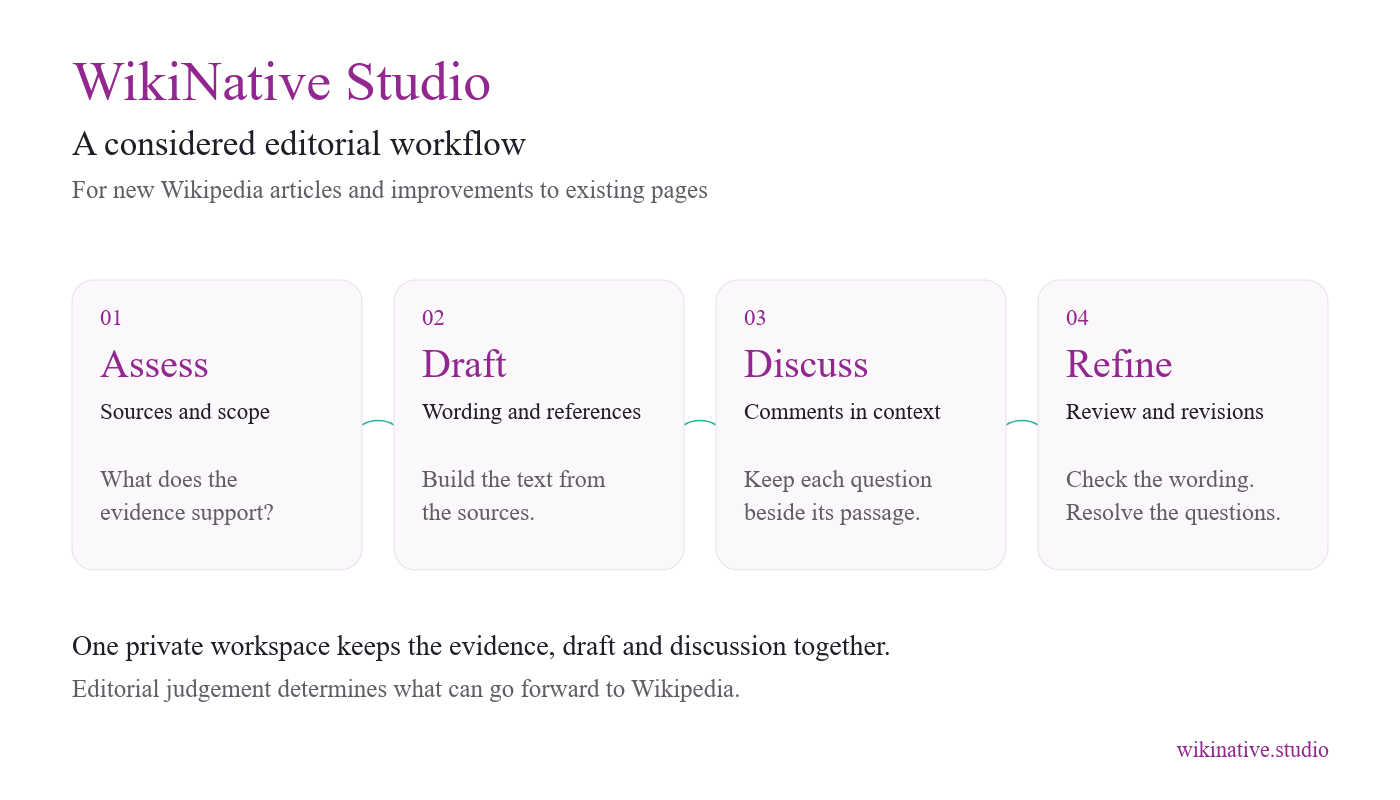
Once the scope is agreed, I inspect the sources, substantiate the notability case and develop the structure around the strongest evidence. I prepare a neutral account, with relevant details in proportion. In Studio, my client can read the proposed article, identify factual problems and discuss particular passages. I can then check those observations against the evidence, revise the wording and explain what I have retained or excluded.
Editing an existing Wikipedia article
An existing article brings another set of considerations. I need to examine the current wording, its references and the changes the client wants. A proposed correction may be straightforward; a substantial rewrite may affect the balance of the whole article.
My Preliminary Viability Assessment examines the request, the article and the sources. It gives me a basis for agreeing the work with you. The assessment itself does not include live editing.
I develop the proposed wording, references and editorial rationale in Studio. That gives the client a specific proposal to review and gives me a place to resolve questions before taking the work to Wikipedia. The existing article remains the point of reference throughout.
Discussing the sentence that needs attention
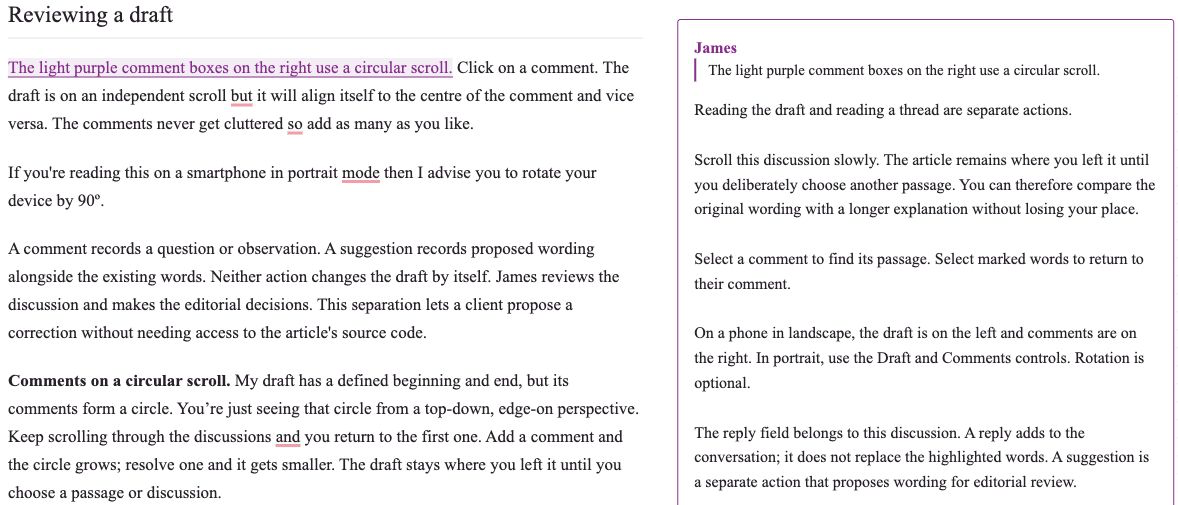
“Please fix the second paragraph” is an ambiguous instruction once a draft has been revised. A discussion attached to the relevant passage makes the question much clearer.
In Studio, a comment records a question or observation. A suggestion records proposed wording alongside the existing words. Neither automatically changes the commissioned draft. I review the discussion, examine any supporting evidence and decide what revision is justified.
This also gives the client a useful way to challenge my work. They can identify the precise sentence, explain the problem and supply a source. I can respond to the same passage without losing the surrounding context.
Knowing when we are both online
WikiNative provides my professional service; WikiNative Studio gives us a private place to work on it. Live presence helps us see when we are both online during my working hours, Monday–Thursday, 9am–5pm UK time. That makes it easier to work through a draft question, discuss a proposed change or share the source needed for the next decision.
My status reflects recent activity, rather than simply being signed in. Outside my working hours, clients see Outside working hours even if I am working. Client presence is limited to authorised members of the same private space, and you can leave feedback at any time.
Presence updates automatically. Saved changes on the draft page, including comments, replies, suggestions, editorial notes and draft revisions, appear automatically. Refresh or reopen separate Discussion pages to see new contributions. A suggestion remains a proposal for me to review; the feature does not share unsaved typing or cursors or add live chat. Online does not promise an immediate reply, uninterrupted availability or a guaranteed response time.
A date correction, worked through properly
Consider a hypothetical editing project. An existing article says a company was “founded in 2008”. The client says the correct year is 2006 and provides a company-register record. The newspaper article cited by Wikipedia describes a public launch in 2008.
Replacing one year with the other would conceal the question I need to answer. Incorporation and a public launch are different events. I first inspect both records to establish what each date describes.
In Studio, the client can attach the question to “founded in 2008” and propose 2006. I can explain the distinction beside that passage. If the sources support it and the detail is relevant to the article, I might propose wording that distinguishes incorporation in 2006 from the launch in 2008. If the evidence does not support that account, I need to revise the proposal.
The client can then review an exact sentence with its references and explanation. A further source may change the answer. The discussion and revision remain connected, so you can see why the wording developed as it did. The same discipline applies to descriptions of someone’s work, changes in an organisation and other apparently simple corrections.
Reviewing the work before it reaches Wikipedia
Studio gives me a private environment in which to check the draft’s wording, references, structure and WikiText, and to work through revisions with the client. It makes the proposed work reviewable before it enters a publicly editable encyclopaedia.
When the work is ready, I publish it from a Wikipedia account in good standing with a track record of useful contributions. Once a Wikipedia entry is live, other editors can and will edit it, but my compliance-based approach and simulated Wikipedia testing flag problematic content prior to the upload.
Studio access and my editorial services
I provide consultancy and editorial services to active WikiNative Studio subscribers, including eligible trial subscribers. Activate your Studio subscription or eligible trial before submitting a brief, links, sources or a draft. This applies to agencies and direct clients alike. The subscription provides the software, features and assessment credits included in your plan. Editorial commissions are scoped and charged separately; subscribing does not buy unlimited editing time.
You can review the current plans and prices before starting a project. To see how the working environment feels, try the interactive demo in WikiNative Studio. Select a marked passage, open its discussion and try proposing a change. It is a sample draft, so you can explore the interface before bringing me your own Wikipedia project.
Card required. Plans from £49/month after seven days, renewing monthly unless cancelled. Cancel before your trial ends to avoid the first subscription payment. One trial assessment per account. Draft Reviews and editorial work are charged separately. Private reports and drafts are reviewed inside Studio under the private-use terms.
The public sample demonstrates the review interface. It does not display my real availability or any private client presence.